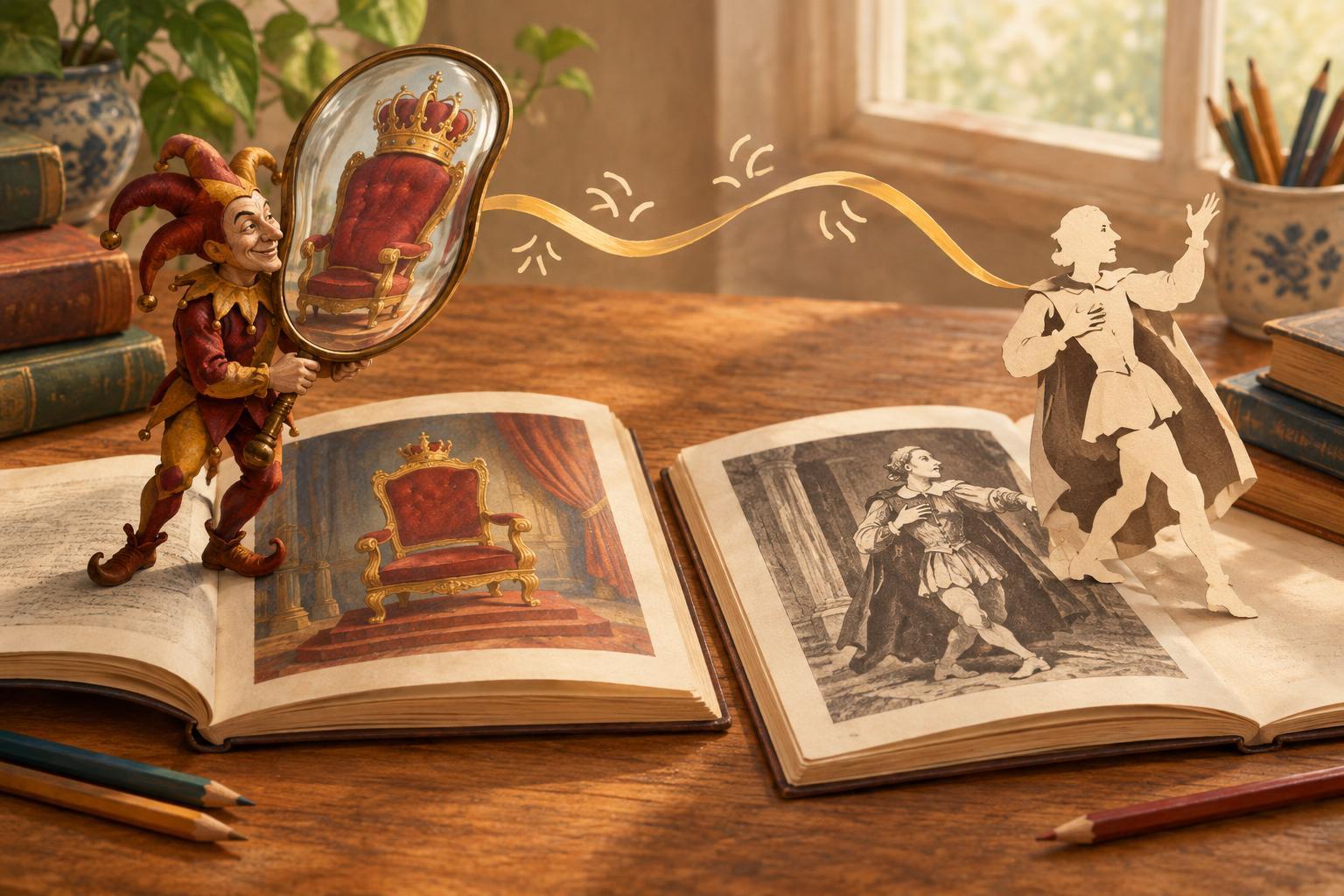
Two kinds of humor, two different aims
Satire and parody often appear together, which makes them easy to confuse. Both may use exaggeration, irony or a straight-faced narrator to make something seem ridiculous. The clearest difference is what the humor is doing. Satire draws attention to a problem in a person’s behavior, a social custom or an institution. Parody imitates the recognizable features of a particular work, creator or kind of writing for comic effect.
Imagine a fictional town where every meeting about fixing a broken bridge begins with a vote to form another committee. The joke points toward indecision and bureaucratic habits: that is satire. Now imagine the same story told in the breathless language of an adventure novel, with a committee agenda presented as a perilous quest. The borrowed style makes it a parody, too. One piece can perform both jobs at once.
Satire asks what deserves a closer look
Satire does not have to announce its opinion. It can create a world in which familiar assumptions are pushed just far enough to become uncomfortable. A character may insist that every minute of leisure must be measured for productivity, even while supposedly relaxing with a book. The humor comes from the gap between that character’s confident reasoning and what the reader can see: rest has become another chore.
The target matters more than the volume of the joke. Satire can be sharp and openly absurd, but it can also be quiet. A polite conversation in which no one will admit an obvious mistake may reveal more than a scene full of punch lines. When reading satire, ask what the work wants you to reconsider. Is it mocking an individual’s vanity, or using that individual to expose a broader habit? Those questions help separate a purposeful critique from humor that simply treats someone as foolish.
Parody depends on recognition
Parody gives readers a second thing to notice: the model being imitated. It might echo the clipped suspense of a thriller, the grand declarations of an epic poem or the soothing promises of a self-help chapter. Its pleasure often lies in seeing a familiar form applied somewhere it does not quite fit. A recipe written as a detective mystery could turn a missing spoon into a dramatic clue and the oven timer into a looming deadline.
You do not always need to know one exact source to enjoy a parody. If it imitates a broad genre, a few recognizable conventions may be enough. But recognizing more of the model can reveal more of the joke. A parody may affectionately celebrate its source, point out repetitive habits within it or do both. Imitation alone is not necessarily criticism: sometimes the humor comes mainly from the surprising match between an elevated style and an ordinary subject.
A useful way to read the overlap
To distinguish the two, try asking a pair of questions. First, what is being imitated? Look for repeated phrases, plot patterns, character types or a distinctive tone. Second, what is being challenged? Look for beliefs or practices that seem increasingly strange as the piece continues. A work that closely mimics a heroic speech about choosing a restaurant is primarily playing with form. If it also exposes how a group turns every small decision into a contest for status, its parody carries a satirical point.
In a book group, it can be rewarding to compare where readers laughed with where they felt a little uneasy. A joke may land because a genre convention is familiar; it may linger because the criticism feels familiar, too. Those reactions are not competing answers. Satire and parody are tools rather than rigid labels, and writers can use them in different proportions. Noticing both the borrowed shape and the idea beneath it makes humorous writing richer to read—and gives a discussion somewhere to go after the laughter.