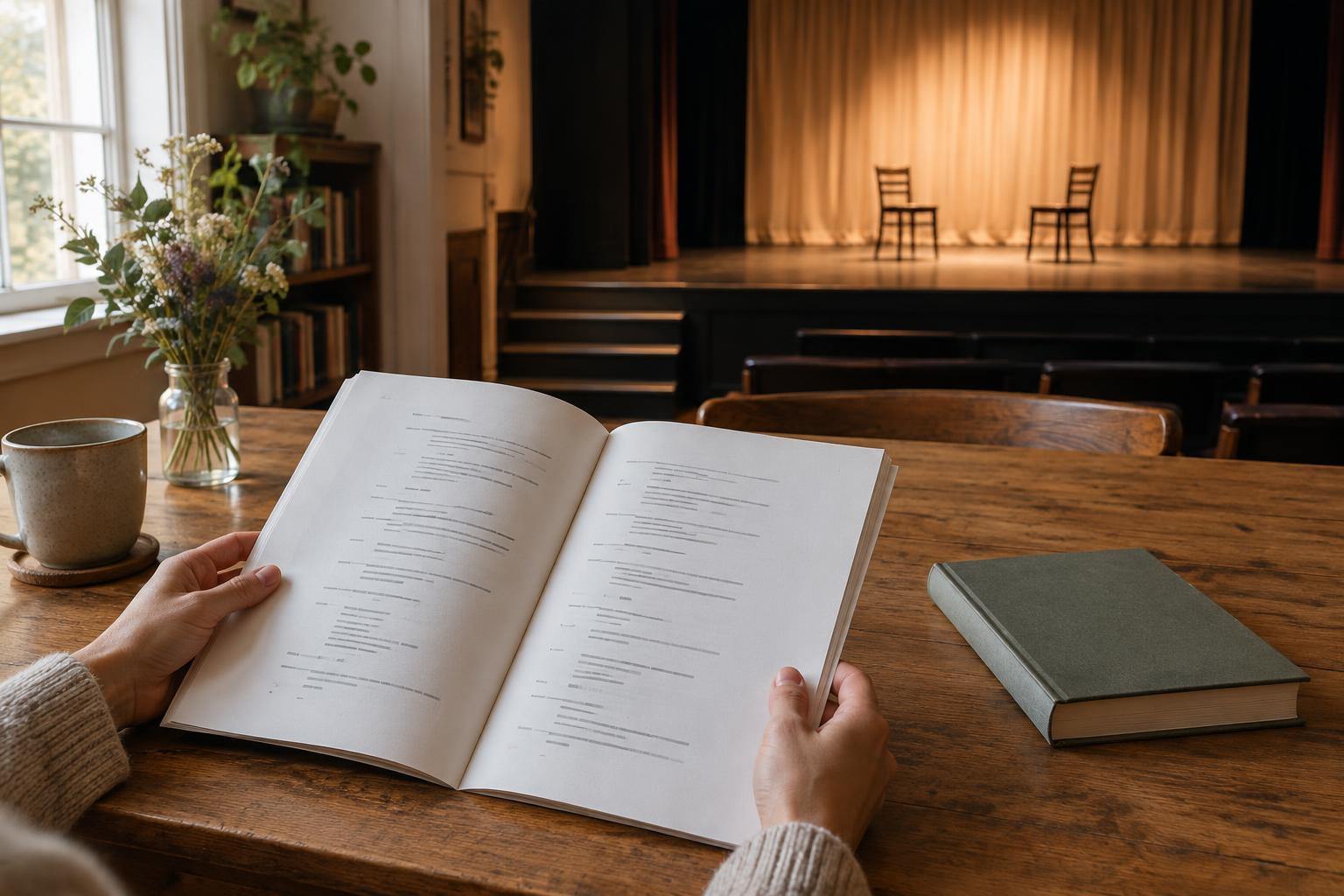
A script gives you a different view of the story
A novel can take you inside a character’s thoughts, describe a room at length, or explain what happened years before the opening chapter. A play usually gives you less of that guidance. Its main materials are what characters say, what they do, and the situations in which they meet. The story is meant to come alive through performers, movement, sound, and an audience’s attention. On the page, you become part reader and part imagined audience.
That does not make a play an incomplete book. Its open spaces are part of the form. A character who says “I’m fine” might be reassuring someone, hiding anger, or hoping to end a conversation. The surrounding lines and actions help you decide what seems likely, but they may not settle the question. Instead of looking for a narrator to explain every feeling, watch for what changes between the start and end of an exchange.
Get oriented before following every line
Before you begin, glance at the list of characters, if there is one. You do not need to memorize it. Notice relationships and any names that look similar, then return to the list when needed. At the start of each scene, pause long enough to identify where the characters are, who is present, and what each person might want. Those three questions can provide a foothold even when the dialogue moves quickly.
Plays often divide action into acts and scenes rather than chapters. A new scene may signal a shift in place, time, or company; it may also bring a conflict into sharper focus. If you lose the thread, look back to the last entrance, exit, or change of scene. Ask what one character is trying to persuade another to do. You can follow the central struggle without catching every allusion or joke on a first reading.
Treat stage directions as clues, not a camera feed
Stage directions may describe a setting, an entrance, a gesture, or a silence. They help you picture the action, but they do not always dictate exactly how a performance must look. A brief direction such as “She turns away” could suggest embarrassment, refusal, or an attempt to conceal a smile. Read the direction alongside the dialogue rather than assigning it a fixed meaning immediately.
Entrances and exits deserve special attention because they change who can hear a conversation. A remark made in private may mean something different once another character arrives. Pauses matter, too: a delayed answer can reveal hesitation even when the words sound confident. Try picturing where people stand and whom they address, but keep the image flexible. Another reader, actor, or production might make a different choice that still fits the text.
Listen for the story beneath the words
In fiction, prose can tell you that a conversation feels tense. In a script, you may have to hear the tension in an interruption, a repeated question, or a sudden change of subject. Characters may speak indirectly because they are being polite, protecting themselves, or testing someone else. When a line puzzles you, ask both what it says and what the speaker hopes it will accomplish.
Reading a short passage aloud can help. You need not perform it well or give every character a distinct voice. Hearing the rhythm often makes a joke, hesitation, or argument clearer. Monologues and speeches benefit from the same approach: rather than treating them as blocks of information, notice where the speaker shifts tactics or addresses a different listener. Even when a character appears to speak alone, the words can reveal a decision taking shape.
Read for possibilities, then discuss your choices
On a first reading, keep moving. Mark a confusing line and return to it after the scene ends, when you know what followed. If the play includes unfamiliar language or references, use any notes provided by your edition without letting each note interrupt the action. A second look at one important exchange is often more rewarding than trying to solve every detail at once.
For a book group or reading partner, choose a scene and ask how it might be played. Which line sounds sincere? Where might someone pause? What would change if a character stayed close to another person instead of walking away? These questions connect the words on the page to the possibilities of performance. Unlike a novel, a play continually invites you to imagine how the same written moment might look and sound in different hands.