Look beyond the familiar landscape
The prairie is a powerful image, but it is not the whole setting of a Kansas story. A character might feel at home on a Wichita street, in a western Kansas town, or along a road connecting the two. Reading across these settings makes it easier to notice what a landscape does in a story rather than treating it as a postcard. Does an open horizon offer freedom, or does it make a character feel exposed? Does a crowded neighborhood offer privacy, or make everyone’s choices more visible?
A useful first question is not simply whether a story is urban or rural. Ask where its characters spend their ordinary days: at work, at school, with relatives, among neighbors, or in transit. Those routines give a place its texture. A city scene can feel quiet and isolated; a remote setting can be full of visitors, obligations, and conversation. Stories grow more interesting when readers let those possibilities remain open.
Read the spaces between city and country
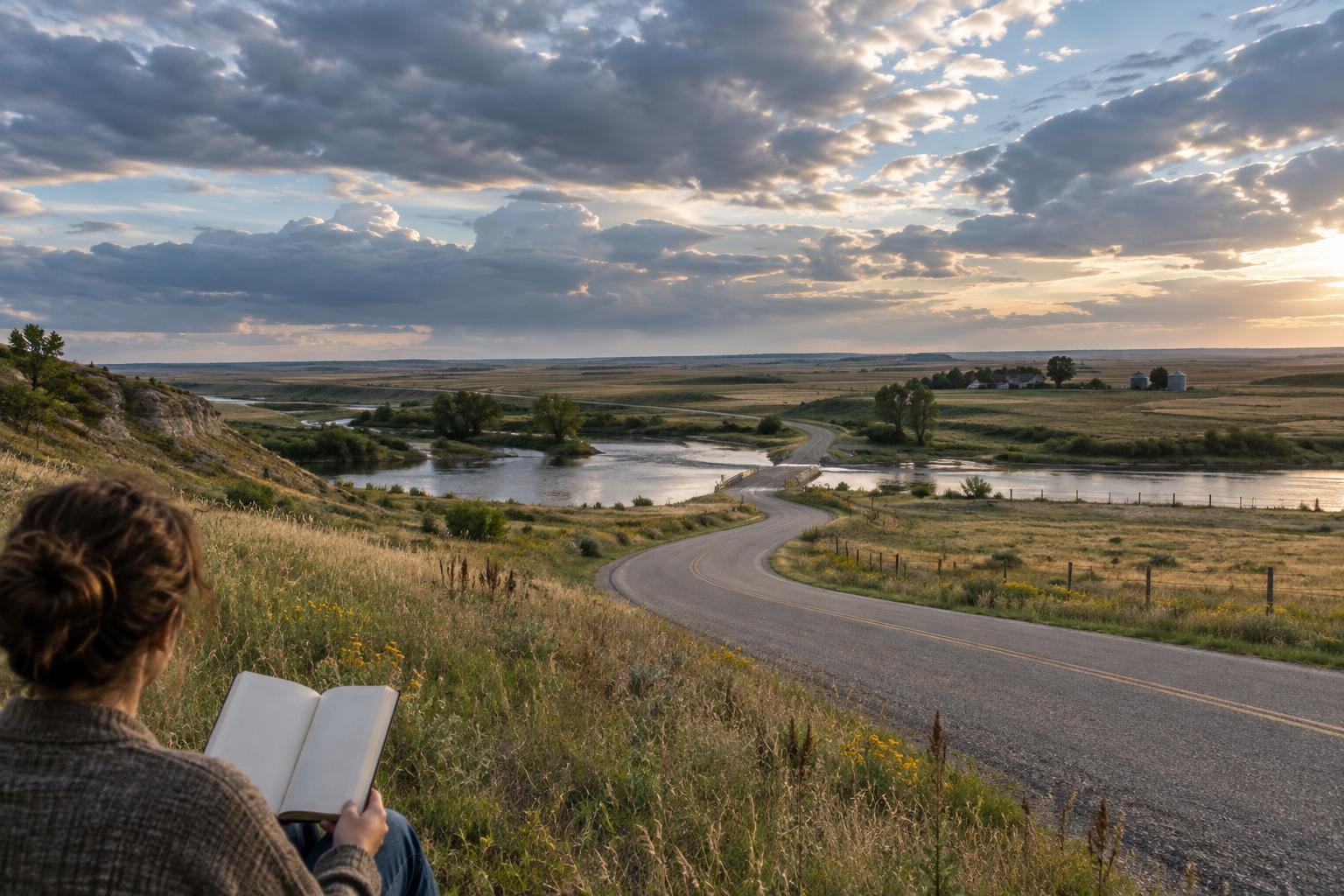
Urban and rural are often presented as opposites, but many Kansas stories can be read through movement between them. A person may leave a small town for a job, return to care for family, or regularly travel between communities. Such journeys can reveal how a character changes the way they speak, what they choose to share, or where they believe they belong. The road is more than a transition between scenes; it can be where competing ideas of home meet.
When reading, pay attention to connections as well as distances. Where do characters go for work, friendship, celebration, or solitude? Which relationships endure across a move, and which become harder to maintain? A story set in one place may still be shaped by another through memory, family history, or a hoped-for future. This approach helps readers see regional identity as something people carry and revise, not something fixed by an address.
Notice whose Kansas comes into focus
No single narrator can stand for an entire state. The same block, town, or stretch of land may mean different things to people of different ages, backgrounds, and family histories. One character may know a place through generations of stories; another may be encountering it for the first time. Neither perspective automatically provides the complete account. A narrator’s attention and omissions are part of what a reader can examine.
Look for details that show how characters understand their surroundings: the names they use for places, the routes they know by heart, the customs they follow, and the spaces where they feel welcome. Notice, too, whose work keeps daily life moving and whose experiences remain at the edge of the narrative. Asking these questions need not turn every discussion into a search for a single correct portrait of Kansas. It can instead make room for several specific, sometimes conflicting views.
Use setting as a book-group conversation starter
For a book group, place offers a way into a story without requiring everyone to know the region in advance. Invite each reader to choose one scene whose setting stayed with them and explain what it added. Did the location create a practical obstacle, shape an encounter, or change the mood? Compare those observations before moving to broader questions about what the book suggests about urban or rural life.
It also helps to separate what the text shows from what readers bring to it. A familiar place may prompt recognition, while an unfamiliar one may invite assumptions. Ask which details support an interpretation and which questions the story leaves unresolved. If your group reads several Kansas-set works, try pairing stories with different settings or narrators. The aim is not to decide which portrayal is most representative, but to see how each writer makes a particular place matter.
Let specific places complicate the map
Readers and writers alike can resist the urge to use a setting as shorthand for a character’s values. A city does not automatically signal opportunity, and a small town does not automatically signal either closeness or constraint. Any of those experiences may appear, but a convincing story shows how they arise for particular people. Details such as a shared errand, a difficult commute, or an unexpected meeting can do more than a broad description of a skyline or field.
Kansas storytelling has room for city neighborhoods, county roads, and lives that cross both. Reading with attention to daily routines, journeys, and differing points of view makes that range easier to appreciate. The reward is not a final definition of the state. It is a fuller sense of how people make meaning in places—and how the same place can hold more than one story.