Start with the people, not the platform
The best book club format is the one members can attend often enough to build a conversation together. Before reserving a table or sending a video link, ask what gets in the way of showing up. Travel time, caregiving, work schedules, mobility needs, internet access, and comfort with technology can all matter. A format that sounds ideal in theory may be difficult to sustain month after month.
Ask members two questions: “Which format could you attend most regularly?” and “What would help you take part in the discussion?” The answers may differ. Someone might reach an online meeting more easily but feel more comfortable speaking around a table. You do not need a perfect solution for every preference. You need an arrangement members understand, can plan for, and are willing to revisit.
In-person meetings: Make room for conversation
Meeting in person gives a group a shared space and a clear break from daily routines. Members can bring a passage to read aloud, pass around different editions, or linger after the formal discussion. Facial expressions and natural pauses may make it easier to tell when someone wants to speak. For groups that value an unhurried social gathering, those qualities can be a strong reason to meet face to face.
The practical details deserve just as much attention as the book choice. Pick a location members can reasonably reach, with seating that lets everyone hear one another. Consider the cost of food or drinks if you meet at a business, and avoid making purchases an unspoken requirement. If you rotate homes, check that hosting feels voluntary rather than expected. A predictable meeting time and a simple way to report an absence can spare the host unnecessary guesswork.
Online meetings: Use structure without making them stiff
An online meeting can bring together readers who live far apart or find travel difficult. It also removes the need for a physical host. The trade-off is that a discussion may need a little more guidance: overlapping voices are harder to sort out, and a pause can feel longer on a screen. Choose a meeting tool members can access, send joining details ahead of time, and leave a few minutes at the beginning for connection problems.
A facilitator can open with a question everyone can answer briefly, such as which scene stayed with them. From there, invite members in without requiring every person to respond to every prompt. Keep a backup way to communicate if the meeting link fails, and agree on whether cameras are optional. These small decisions let readers focus on the book rather than on the mechanics of the call.
Hybrid meetings: Include remote readers deliberately
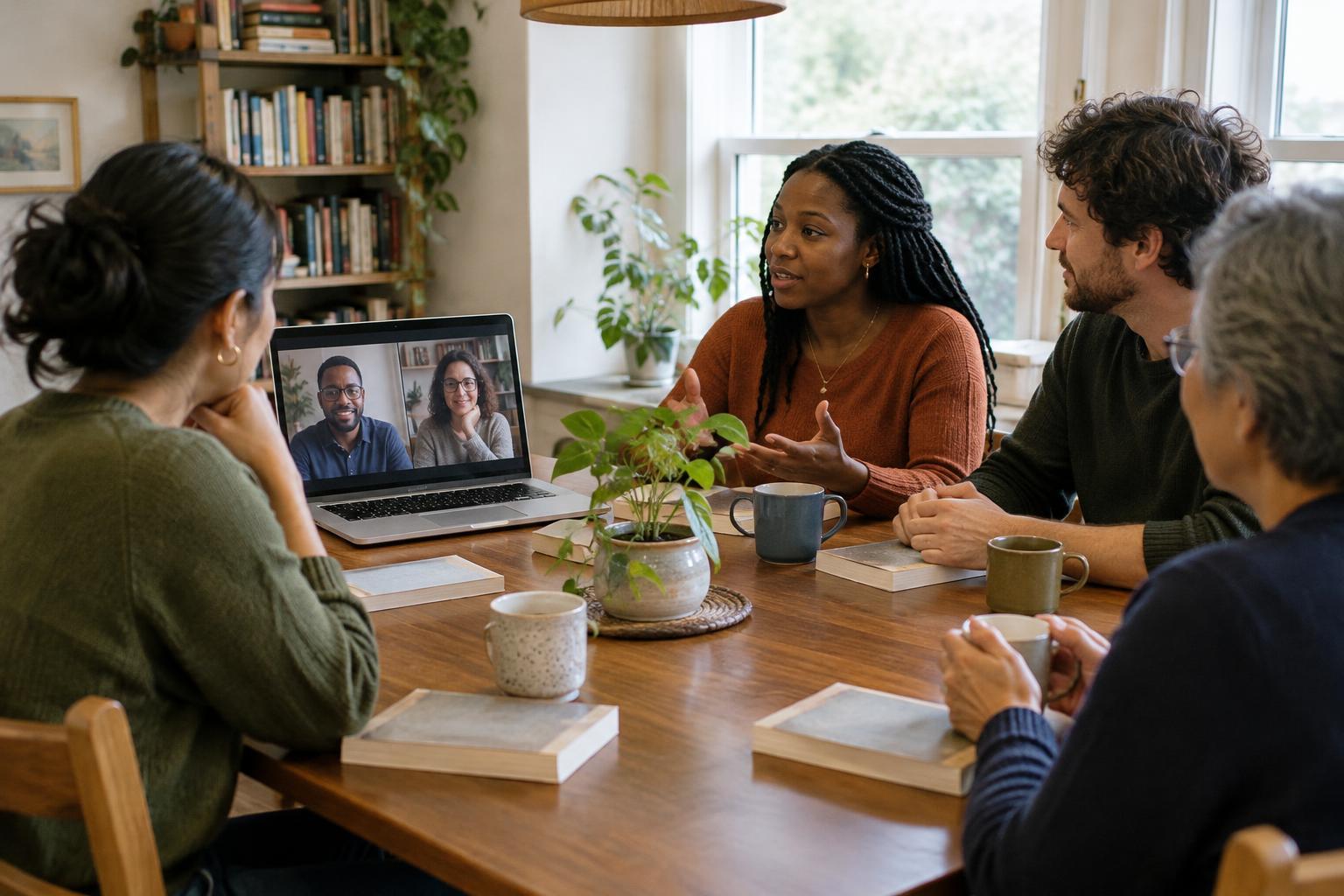
A hybrid meeting combines a room of readers with people joining remotely. It can be useful when some members strongly prefer gathering in person and others cannot regularly get there. Yet placing a laptop at the end of a table is not, by itself, an inclusive plan. Remote members need to hear speakers clearly, see enough of the room to follow the exchange, and have a reliable way to enter the conversation.
If your group tries hybrid, assign one person in the room to watch for remote participants who want to speak. Have in-person members take turns rather than talking across one another, and repeat a question if the microphone did not catch it. Test the setup before the full discussion begins. If the sound remains poor, consider alternating fully in-person and fully online meetings instead; that may serve everyone better than a hybrid call that leaves some readers on the margins.
Try a format, then ask what worked
You can treat the choice as a short experiment rather than a permanent rule. Try a format for two or three meetings, keeping the book selection and meeting length manageable. Afterward, ask members whether they could attend, whether they had a fair chance to speak, and what made participation difficult. Pay attention to quiet members as well as frequent speakers; attendance alone does not tell you whether the discussion worked.
Write down a few shared expectations before the next meeting: the start and end time, how books are chosen, how to join or find the venue, and who will guide the conversation. You might keep one regular format while making occasional exceptions for travel or seasonal schedules. A good book club format is not the most elaborate one. It is the one that helps people return, listen closely, and leave with something new to think about.