Let the draft become something you can read
Finishing a first draft gives you a whole piece to work with, but it does not mean every part is ready for a careful sentence edit. A beautifully phrased opening may no longer belong once you understand what the piece is really about. Before changing individual words, take a little distance from the draft if you can. Even a short break can make it easier to notice what is on the page rather than what you intended to write.
Read the draft from beginning to end without stopping to fix commas or rewrite awkward lines. Keep a separate note for observations: where your attention rises, where it wanders, what confuses you, and what feels unexpectedly alive. Mark questions rather than solutions. If a scene seems slow, for example, you do not yet need to cut it. You need to ask what the scene contributes and whether the reader has enough reason to care.
Name the piece’s central purpose
After that first read, describe the draft in one or two plain sentences. For a story, try naming whose experience drives it, what changes, and why that change matters. For a personal essay, identify the question the narrator is exploring rather than only the events being described. For a poem, consider the movement of its images, voice, or ideas. This description is a working tool, not a promise that the piece must stay as it is.
Compare your description with the actual draft. Does the opening point toward the same concern as the ending? Are there passages you enjoy that lead away from the piece’s strongest direction? A first draft often discovers its subject while being written. Revision gives you a chance to make that discovery visible to a reader. If you cannot yet name the central purpose, write down two or three possibilities and use the next pass to test them.
Map the structure before moving sentences
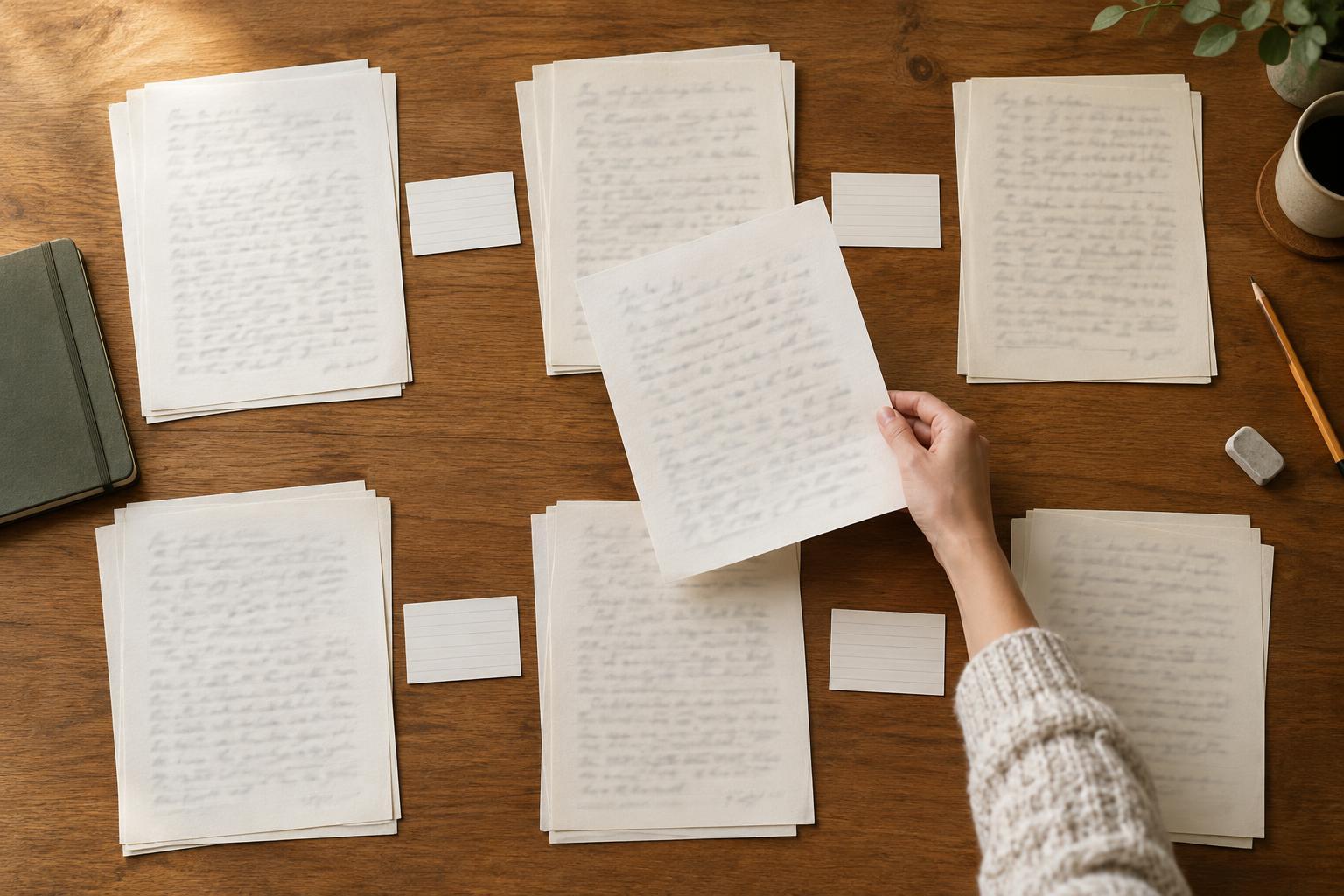
Make a brief outline of the draft as it exists now. Give each scene, section, or major paragraph a short label describing what happens or what new idea appears. This reverse outline can reveal repetition, missing steps, and stretches that ask the reader to wait too long for a development. It also separates the work of understanding the structure from the harder work of changing it.
Look at the map and ask what each part does. Does it introduce a question, complicate it, provide context, change a relationship, or offer a turn in thought? Some passages may serve more than one purpose. Others may be appealing but have no clear role. Try possible changes on the outline first: move a section, combine two similar moments, or begin closer to the point of tension. You can then revise the manuscript with a plan instead of repeatedly polishing material you may remove.
Repair missing connections and uneven emphasis
Once the broad order makes sense, examine what the reader needs at each step. A character’s decision may require more preparation; an essay’s conclusion may need an example that tests its main idea. Conversely, a point explained three times may need only its clearest version. Add, cut, or expand material according to its effect on the whole piece, not according to how much effort it took to write.
Pay particular attention to transitions in meaning. If one scene follows another, what has changed between them? If an essay moves from a memory to a larger reflection, can the reader follow that move? A transition is not always a linking sentence. Sometimes the real repair is a missing scene, a better example, or a different order. Read around each proposed change to see whether it creates a new gap elsewhere.
Choose a stopping point for big-picture revision
Structural revision does not have a perfect finish line. A useful test is whether you can explain why the major parts are present and why they appear in their current order. The draft should give a reader enough to follow its movement, even if particular sentences remain rough. If a trusted reader is available, ask about their experience of the whole piece: where they felt engaged, what they expected next, and where they needed more information. Those answers are more useful at this stage than a list of typos.
Then turn to paragraphs and sentences. You can strengthen the voice, trim repetition, clarify references, and attend to rhythm without wondering whether entire sections will disappear. Keep a copy of earlier versions so that cutting a passage does not feel like losing it forever. Revising before line editing is not a rule against writing a good sentence. It is a way to spend your attention where it can make the greatest difference first.