Begin with the story’s own clues
A story set in your community may name a street you walk every week, describe a vanished business or mention an event you have heard about from relatives. Before looking anything up, read with a pencil nearby. Note place names, occupations, forms of transportation, school or church life, seasonal routines and references to local events. Record the page or passage where each clue appears so you can return to it later.
Then make a short list of questions rather than assumptions. Was that building standing when the story takes place? What work was available nearby? How might people have traveled between the places named? Separate details the story states from details you have inferred. A precise date or address gives you one kind of starting point; a mood or a remembered custom calls for a broader search.
Build a small timeline and map
Identify the story’s approximate period, even if the author never gives a year. Look for clues such as a new road, a closed railway station or a character’s recollection of an earlier generation. Place the events in a simple timeline with three columns: what happens in the story, what you want to check and what you find. Leave uncertain dates as ranges rather than forcing them into a single year.
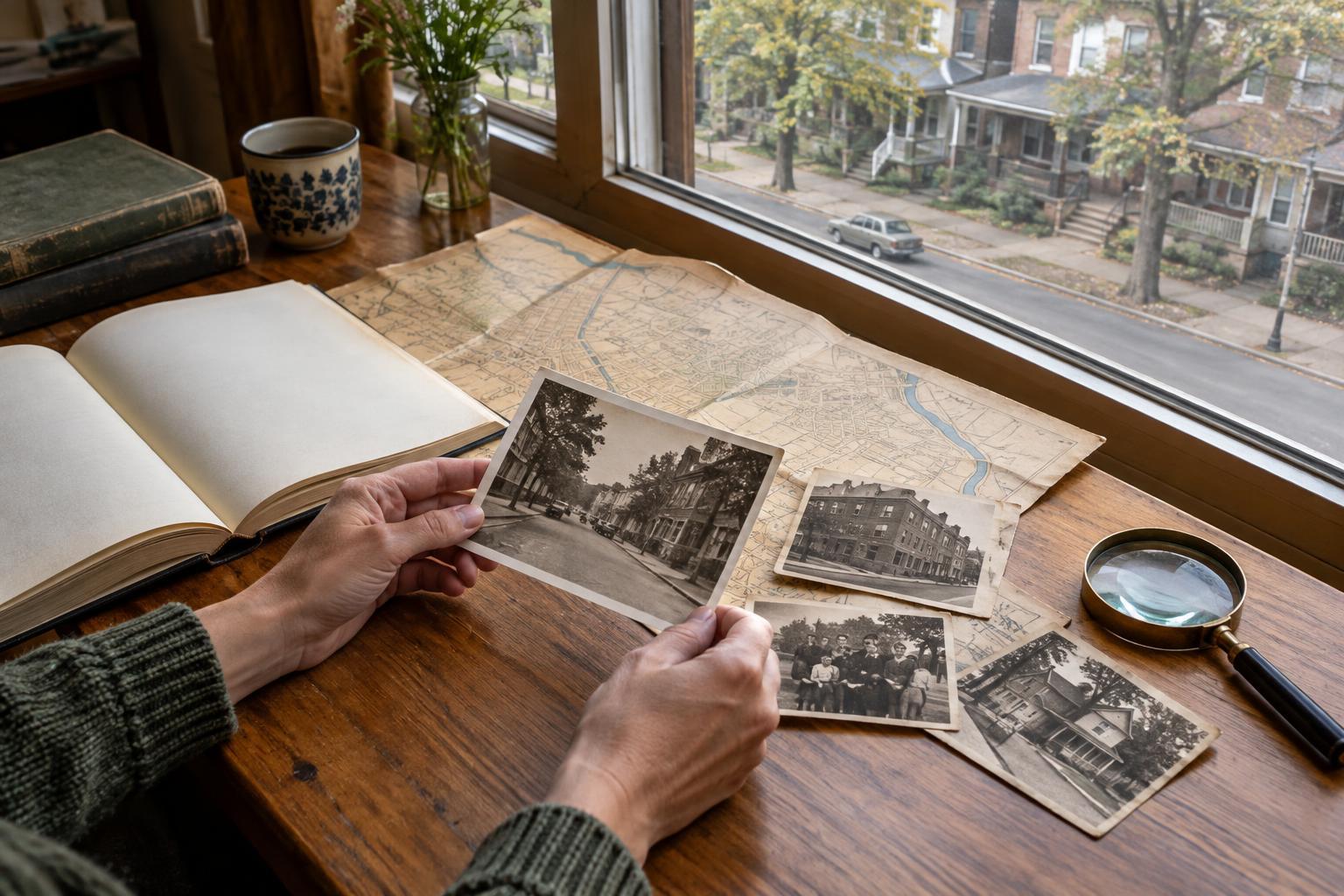
A map can reveal questions a timeline misses. Compare the story’s route through town with an older map if one is available. Street names and boundaries can change, and a landmark may have moved or disappeared. Start with a few locations central to the plot instead of trying to reconstruct the whole community. If you cannot locate a place, it may be fictional, renamed or described from a character’s limited point of view.
Look for records that answer specific questions
Local history collections, archives, museums and newspaper collections can be useful places to search. Depending on what has been preserved, you might find city directories, photographs, property records, school publications, maps or accounts of public events. Ask a narrow question before opening a collection: for example, whether a neighborhood had a grocery store during the story’s period. A focused question makes a large set of records less overwhelming.
Read each item with its limits in mind. A photograph shows what was visible to the camera, not everything happening nearby. A newspaper may describe an event from one perspective and omit people who were affected by it. A directory may help establish that a business existed without telling you what it felt like to work or shop there. When possible, compare different kinds of records before settling on an interpretation.
Make room for memory and missing voices
Family stories, interviews and community recollections can add texture that official records lack: how a street sounded, which gathering places mattered or what neighbors called a particular corner. If someone is willing to share a memory, ask open questions and let them decide what they want to tell. Write down who shared the account and when, with their permission. Treat the memory as a valuable perspective, not a complete record of the past.
Also notice whose experiences are easy to find and whose are not. A story may center people who rarely appear in surviving documents, or records may use names and categories that do not match how people described themselves. An absence in your search is not proof that a person or practice was absent from the community. It is a reason to describe the limits of what you found.
Return to the story with better questions
Once you have gathered a few reliable points of context, reread a scene that first caught your attention. Does knowing the area’s layout change how you understand a character’s journey? Does a detail about local work or gathering places make a conversation more meaningful? Historical context can deepen a reading without turning the story into a test of accuracy. Authors may combine locations, alter timelines or invent events to serve the work.
For a book group or family discussion, bring one passage and one piece of context, then ask what each helps you see. Share where the information came from and name any uncertainty. The goal is not to prove that a fictional scene happened exactly as written. It is to understand how a writer draws on place, and to leave with sharper questions about the community you know.